
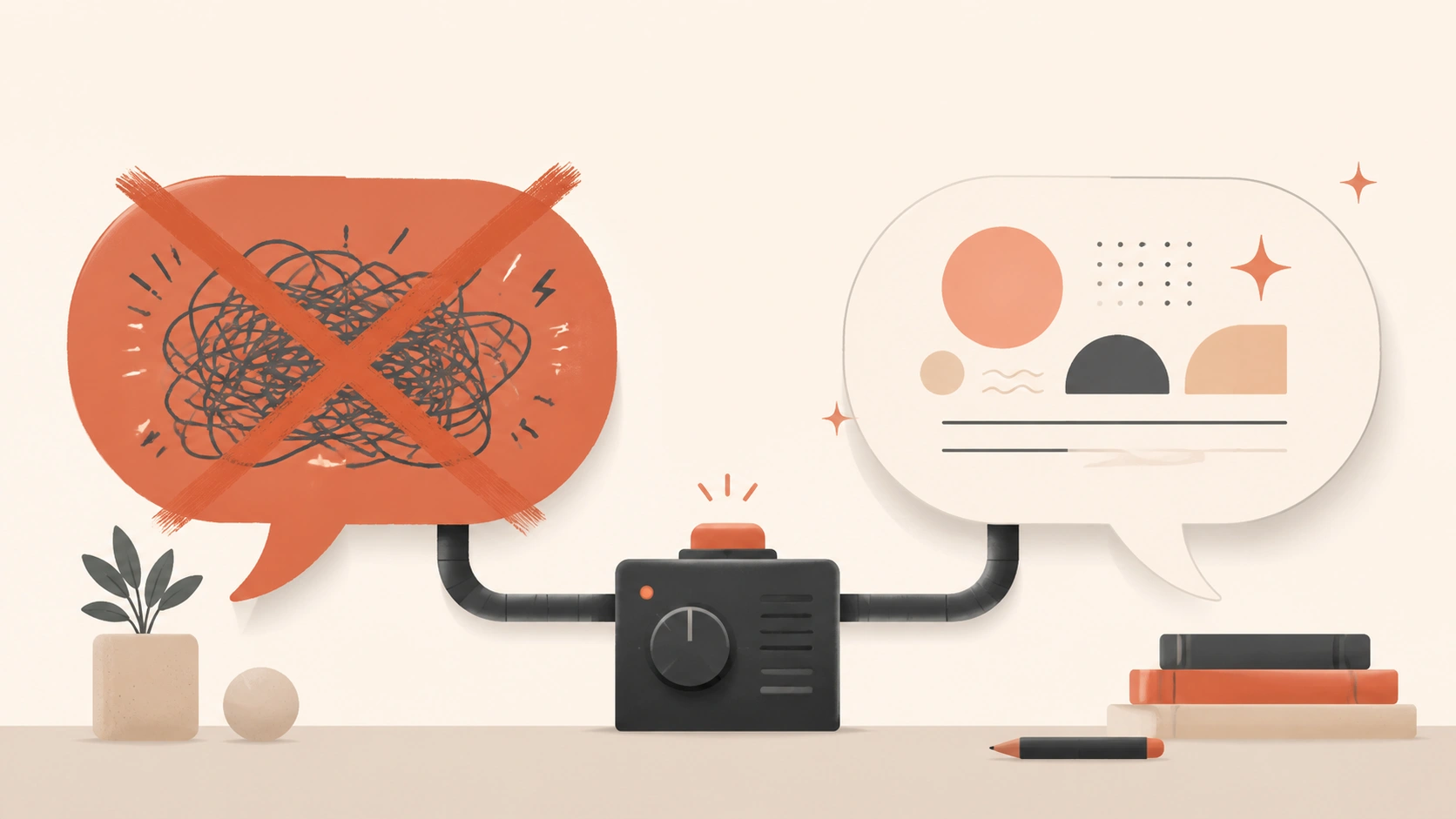
What you want to say versus what to actually send: 50 professional translations for chasing replies, saying no, disagreeing and owning mistakes, all copy-paste ready.
bolt Quick answer
To say something professionally, keep the message and drop the dig. Name what you actually want, stay direct, add a line of warmth, and cut anything that just scores a point. “Did you read my email?” becomes “Just checking this reached you - happy to resend.” Same meaning, none of the friction.
We've all typed the honest version and then deleted it. This is the translator: 50 things you're tempted to fire off at work, each rewritten into something you can actually send - for chasing replies, saying no, disagreeing, flagging someone's mistake, owning your own, guarding your time, surviving meetings, and asking for what you need. Every professional version has a copy button.
One thing worth being clear about: professional doesn't mean passive-aggressive, and it definitely doesn't mean fake. “Per my last email” is technically polite and quietly hostile - and it's everywhere. A Preply survey found that 83% of employees receive passive-aggressive emails and 44% admit to sending them. The goal here is the opposite of that: keep the honesty, add a little warmth, and remove the friction that makes people brace when they see your name.
The formula: how to professionally say (almost) anything
Every translation below follows the same four moves. Learn these and you can rewrite anything on the fly.
- Keep the message, lose the emotion. The point is usually valid; it's the tone doing the damage.
- Say what you want to happen. End on a clear ask or next step, not a complaint.
- Add one line of warmth or shared goal. “I know it's busy” or “happy to help” costs nothing and changes everything.
- Cut the score-settling. Delete “per my last email,” “as I already said,” and “obviously.” They only signal irritation.
Got a blunt draft open right now?
Paste it into the Grammar & Tone Fixer and get the professional version back in seconds - keep the meaning, fix the tone.
When you're chasing a reply
The follow-up is where most passive-aggression creeps in. Keep the nudge, lose the guilt trip.
1Tempted to sayDid you even read my email?
Just checking this reached you - happy to resend if it's easier.
2Tempted to sayYou've ignored me three times now.
I know things are busy, but this is now blocking [X]. Could you take a look today?
3Tempted to sayPer my last email...
Following up on my note from [day] - pulling the key point up top so it's easy to action: [point].
4Tempted to sayHello?? Anyone there?
Gentle nudge on this one - is it still on your radar for this week?
5Tempted to sayI need this NOW.
This has become time-sensitive; I'd need it by [time] to stay on track. Is that doable?
6Tempted to sayStop leaving me on read.
No rush if you're heads-down, but a quick yes or no would unblock me here.
When you're saying no or pushing back
A clear no with a reason lands better than a reluctant maybe you'll resent later.
7Tempted to sayThat's not my job.
That sits outside what I own - [Person or Team] would be the right people. Happy to make the intro.
8Tempted to sayI don't have time for this.
I can't take this on without dropping something else. Which of [A or B] should I deprioritise?
9Tempted to sayYou're dumping this on me.
I want to help, but I'm at capacity this week. Could we push the start to [date] or share the load?
10Tempted to sayAbsolutely not.
I don't think that's the right move for us, and here's the trade-off I'm worried about: [X].
11Tempted to sayFigure it out yourself.
You've got everything you need for this one - happy to be a sounding board if you get stuck.
12Tempted to sayNo. Just no.
I'll have to pass on this one; it's not something I can prioritise right now.
13Tempted to sayWhy is this suddenly urgent?
Can you help me understand the deadline driver? I want to sequence this correctly against [other work].
When you disagree
You can hold your ground and stay collaborative. Lead with curiosity, then the concern.
14Tempted to sayThat's a terrible idea.
I see it differently - can I walk through a couple of risks before we commit?
15Tempted to sayThis makes no sense.
I might be missing context - can you help me understand the thinking here?
16Tempted to sayWe already tried that; it failed.
We went down a similar road before and hit [issue] - worth checking what's changed so we don't repeat it.
17Tempted to sayYou clearly haven't thought this through.
A few things aren't clear to me yet - how are we planning to handle [X] and [Y]?
18Tempted to sayHard disagree.
I'm not aligned on this one and I'd value talking it through; my main concern is [X].
19Tempted to sayThat's above my pay grade.
That's really a call for [role] - I'd loop them in before we decide.
When someone dropped the ball
Point at the problem, not the person. Assume a fix is possible and invite them into it.
20Tempted to sayYou broke it.
Looks like something went sideways with [X] after [change] - can we take a look together?
21Tempted to sayThis is completely wrong.
I think a few things are off here; flagging them so we can get it right: [list].
22Tempted to sayDid you even test this?
I hit [issue] when I tried it - can you confirm the expected behaviour on your end?
23Tempted to sayYou missed the deadline.
I noticed [deliverable] didn't land on [date] - where does it stand, and is anything blocking you?
24Tempted to sayThis is a mess.
This needs a bit of clean-up before it's ready - happy to walk through what I'm seeing.
25Tempted to sayYou never told me that.
I don't think I had that context - can we capture it somewhere we both see going forward?
When you've made the mistake
Owning it early, with a plan, reads as competence. Excuses and vagueness do the opposite.
26Tempted to sayMy bad, I forgot.
That one's on me - I dropped it. Here's how I'm fixing it and by when: [plan].
27Tempted to sayI have no idea what I'm doing.
I want to get this right and I'm not fully up to speed - could you point me to the best example to follow?
28Tempted to sayI completely messed this up.
I made an error on [X]. I've flagged it early; here's the impact and my plan to put it right.
29Tempted to sayI didn't do it yet.
I haven't got to this yet - realistically I can have it done by [date]. Does that work?
30Tempted to sayI don't know.
I don't have that to hand - let me find out and come back to you by [time].
31Tempted to sayI forgot you existed.
Apologies for the slow reply - this got buried. Picking it up now.
When you're protecting your time
Boundaries are more respected when they come with a when, not just a no.
32Tempted to sayStop pinging me.
I'm heads-down on [X] this morning - I'll be back on messages after [time].
33Tempted to sayThis could've been an email.
Would it be more efficient to handle this async so we keep everyone's calendars clear?
34Tempted to sayI'm not working this weekend.
I'll pick this up first thing Monday - I'm offline over the weekend.
35Tempted to sayLeave me alone, I'm busy.
I'm in focus time until [time] - can this wait, or is it genuinely urgent?
36Tempted to sayBook a meeting like a normal person.
Happy to talk this through - grab a slot on my calendar and I'll come prepped.
37Tempted to sayThat's a you problem.
That's really owned on your side; let me know if you need a steer, but I can't take it on.
38Tempted to sayI'm drowning here.
I'm over capacity right now - I'd need to pause something to take this on. Can we prioritise together?
When the meeting is the problem
Redirect towards a decision without naming and shaming. Time is the shared enemy, not the room.
39Tempted to sayThis meeting is pointless.
What's the decision we're trying to reach today? Want to make sure we use the time well.
40Tempted to sayYou're rambling.
In the interest of time, can we land on the key action here?
41Tempted to sayWhy am I even in this meeting?
Do you need me for the whole session, or just the part on [X]? Happy to drop off after.
42Tempted to sayWe're going in circles.
It feels like we're looping - can we park this and take it offline with the people it affects?
43Tempted to sayNobody read the doc.
I'll give a two-minute recap for anyone who hasn't had a chance to read the doc yet.
44Tempted to sayCan we please just decide?
What do we need in order to decide today? If it's [X], let's get it and move.
When you need something
Make the ask easy to say yes to: specific, scoped, and with a reason.
45Tempted to sayWhat do you actually want?
Can you clarify what 'done' looks like here so I build the right thing first time?
46Tempted to sayGive me a straight answer.
Just so I'm clear - is that a yes, or a not-yet? Either is fine, I just want to plan around it.
47Tempted to sayHurry up.
Any sense of timing on this? I'm sequencing my week and want to slot it in properly.
48Tempted to sayYou need to pay me for this.
This is outside our current scope - happy to take it on as a separate piece of work. Shall I put together a quick estimate?
49Tempted to saySend me the thing.
Could you share [file or link] when you have a moment? I'll take it from there.
50Tempted to sayJust say what you mean.
Want to make sure I'm reading this right - are you asking me to [X], or [Y]?
How to sound professional without sounding fake
A rewrite fails when it swaps honest bluntness for veiled hostility. These are the tells to avoid so “professional” reads as respect, not resentment.
- Retire the classics. “Per my last email,” “please advise,” and “as previously stated” are the most-flagged passive-aggressive phrases for a reason. Say the actual thing instead.
- Don't weaponise “gentle.” A fifth “just a gentle reminder” isn't gentle. If it's now urgent, say so plainly and give a time.
- Warmth beats length. One friendly line does more than three sentences of hedging. Long and careful often reads as annoyed.
- One ask per message. Bury the request under context and it gets missed - then you're back to chasing.
- Match the channel. A quick Slack “can you confirm?” rarely needs the full email formality; over-formalising a small ask can itself read as cold.
Rewrite it in one click
The Grammar & Tone Fixer takes your draft and returns a clear, professional version - pick the tone, keep the meaning.
For the situations that need a full message rather than a one-liner, see our guides on how to say no without being rude and how to politely decline an email.
Frequently asked questions
How do you professionally say something rude or blunt?
Keep the message and drop the dig: name what you want to happen, stay direct, add one line of warmth, and cut anything that only scores a point. For example, "Did you even read my email?" becomes "Just checking this reached you - happy to resend." Same meaning, none of the friction.
What can I say instead of "per my last email"?
"Per my last email" reads as passive-aggressive, so say the actual thing: "Following up on my note from [day] - pulling the key point up top so it's easy to action: [point]." It's warmer, clearer, and usually gets a faster reply.
How do I professionally say "that's not my job"?
Redirect without the resentment: "That sits outside what I own - [Person or Team] would be the right people. Happy to make the intro." It stays helpful while making the ownership clear.
How do you professionally say "I don't know"?
Turn it into a next step: "I don't have that to hand - let me find out and come back to you by [time]." Committing to check reads as reliable, not uninformed.
How do I politely say "this meeting could have been an email"?
Aim at efficiency, not the organiser: "Would it be more efficient to handle this async so we keep everyone's calendars clear?" It makes the same point without the dig.
Is being professional the same as being passive-aggressive?
No - they're opposites. Passive-aggressive language such as "per my last email" is polite on the surface and hostile underneath. Professional means clear and warm: you keep the honesty and remove the friction, rather than hiding irritation behind manners.
How do I professionally disagree or say someone is wrong?
Lead with curiosity, then the concern: "I see it differently - can I walk through a couple of risks before we commit?" Framing it as a question invites a conversation instead of a stand-off.