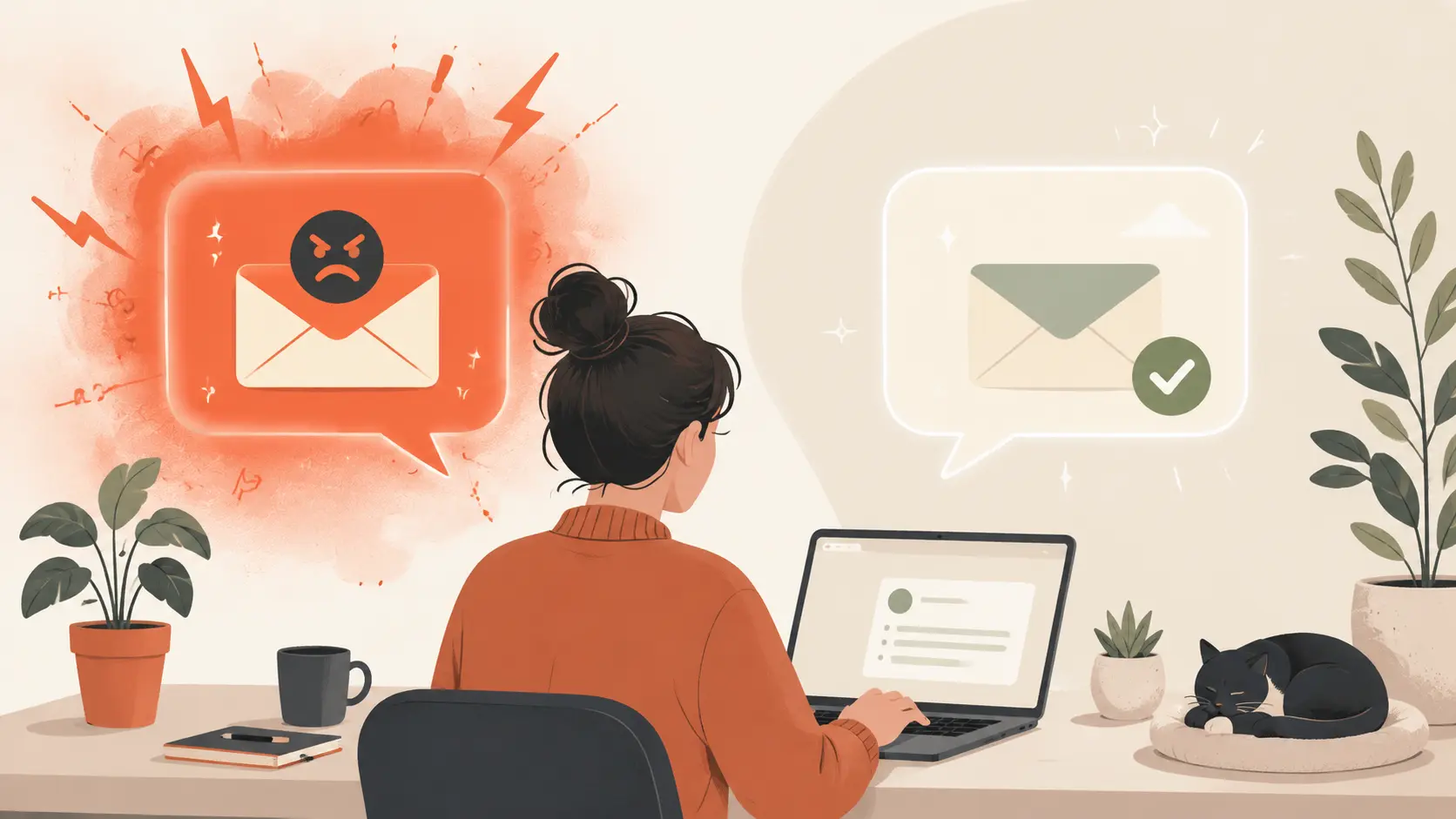


Need to say no without burning bridges? Copy these 12 professional templates for declining meetings, requests, offers, and invitations — politely and clearly.
Most people overthink declining an email. They write three apologetic paragraphs, hedge with a soft maybe, and end up agreeing to something they did not want to do — or ghost the sender and look unprofessional later. Knowing how to politely decline an email is a small communication skill that quietly protects your time, your reputation, and your relationships.
This guide gives you five short principles, then 12 copy-paste decline email templates for the situations you actually face — meetings, scope creep, sales pitches, job offers, freelance work, client requests, and more.
For the shorter moments that need a one-line rewrite, see our guide on how to professionally say (almost) anything; and when the email you're declining was itself rude, here's how to respond to a rude email.
§ 01 — The Frame Five principles for declining an email politely.
Open with appreciation, not apology.
"Thanks for thinking of me" lands better than "I am so sorry to say." Apology framing makes the no sound heavier than it is.
Decline clearly, in one sentence.
Avoid soft maybes like "I might not be able to." Use "I will not be able to" or "this is not the right fit." Clarity is the kindest part of the message.
Give one short reason — not five.
One honest line is enough. Over-explaining sounds defensive and invites negotiation.
Offer an alternative only when you mean it.
A referral, a different time, a quick async update — but only if you actually want to. Empty alternatives create follow-up emails you do not want.
End warmly, in one line.
"Wishing you the best with it" or "looking forward to working together on something soon" closes the door without slamming it. A warm close is what makes the no read as polite rather than cold.
A polite no is short, clear, and warm.
A rude no is long, vague, and apologetic.
§ 02 — The Templates Twelve scripts for the most common asks.
Pick the scenario closest to yours, copy the template, and adjust the bracketed parts. Each one is built around the five principles above — appreciate, decline, reason, alternative, close.
Decline a meeting request.
When the meeting is not the right use of your time, or the topic could be handled async.
Hi [Name],
Thanks for the invite. I am going to bow out of this one — my plate is full this week and I do not think I would add much to the discussion. Happy to share thoughts async if you send the doc over.
Best, [Your name]
Offering async input is the small generosity that keeps the relationship warm without committing to the meeting itself.
Decline a double-booked meeting.
When the time genuinely does not work and you want to suggest a fix.
Hi [Name],
Thanks for setting this up. I am already booked at that time. Could we move it to [day/time], or would it work for [colleague] to join in my place?
Cheers, [Your name]
Give two concrete options. It is much faster to resolve than an open-ended "let me know what works."
Decline scope creep from your boss.
When you are asked to take on something that will quietly displace existing priorities.
Hi [Manager],
Happy to help where I can. Before I take this on, I want to flag that I am currently committed to [project A] and [project B] this week. If this new piece is the priority, which of those would you like me to deprioritise? Let me know how you would like me to play it.
Best, [Your name]
This is not really a no — it is a clarity request. It almost always results in the new ask getting dropped, deferred, or properly scoped.
Decline a new project assignment.
When you have to say no to something that is not in your remit.
Hi [Name],
Thanks for thinking of me. I am going to pass on this one — it sits outside the scope of what I am focused on this quarter, and I would not be able to give it the attention it deserves. [Colleague name] might be a better fit if you have not already asked.
Best, [Your name]
Suggesting an alternative person turns a refusal into a useful redirection.
Decline a favour from a colleague.
When a peer asks you for something you cannot or do not want to do.
Hi [Name],
Wish I could help, but I am stretched thin this week and would not be able to give this the time it needs. If you are still stuck on Friday, send me a quick note and I will see if I can take a look then.
Best, [Your name]
A conditional later-help line is the polite equivalent of leaving a door cracked open.
Decline a sales pitch or cold email.
When you want to close the loop without ghosting.
Hi [Name],
Thanks for reaching out. We are not looking to make a change here right now, but I appreciate you taking the time to explain it. If anything shifts on our side, I will be in touch.
Best, [Your name]
A short, clear no on a cold pitch is more professional than silence — and it stops the follow-up sequence.
Decline a job offer.
When you need to turn down a role without burning the bridge.
Hi [Hiring manager],
Thank you so much for the offer — it genuinely means a lot. After thinking it through, I have decided to go in a different direction and will not be accepting. I really enjoyed meeting the team and hope our paths cross again.
Wishing you the best with the role, [Your name]
Keep the reason short and honest. You do not owe a full explanation — just gratitude and clarity.
Decline an interview.
When you have decided not to move forward with a process.
Hi [Recruiter name],
Thanks for the time and for considering me. After reviewing the role more closely, I have decided it is not the right fit for what I am looking for next, so I will be stepping out of the process. I appreciate you reaching out and hope we can stay in touch for future opportunities.
Best, [Your name]
Decline early in the process — not after the third round. Recruiters remember candidates who close loops cleanly.
Decline a freelance project.
When a project does not fit your scope, capacity, or rate.
Hi [Name],
Thanks for the brief — it looks like a great project. It is not the right fit for me right now: [outside my core focus / schedule fully booked through (month) / too close to a conflicting client]. If it would help, I am happy to recommend a couple of people who would be a strong match.
Best, [Your name]
Naming the specific reason (capacity, fit, conflict) signals professionalism and removes the awkward "are you sure?" follow-up.
Decline a vendor or supplier.
When you have gone through a pitch or proposal process and chosen someone else.
Hi [Name],
Thank you for the proposal and the time your team put into the call last week. After reviewing all the submissions, we have decided to move forward with another provider whose approach was closer to what we needed for this particular project. We really appreciated working with you on this and will keep your details on file for future work.
Best, [Your name]
Closing the loop with vendors who pitched is a small courtesy that builds long-term reputation in your industry.
Decline a client request out of scope.
When a client asks for something not covered in the agreement.
Hi [Client name],
Thanks for sending this over. This piece is outside the scope of what we agreed on in the original brief, so I will not be able to include it in the current project. If you would like to add it, I can put together a quick estimate and timeline — just let me know.
Best, [Your name]
Frame the no as a scope clarification, not a refusal. It positions you as professional, not difficult.
Decline a social or networking invitation.
When you need to say no to a work-adjacent event without sounding cold.
Hi [Name],
Thanks so much for the invite. I will not be able to make it this time — I have something on that evening — but I would love to grab a coffee one-on-one in the next couple of weeks if you are around.
Best, [Your name]
Offering a smaller, lighter alternative (coffee, a call) keeps the relationship warm without committing to the bigger ask.
§ 03 — Before You Hit Send Three quick tone tests.
- Read it out loud. If it sounds stiff or apologetic when spoken, it will read that way too. Cut the second "unfortunately" and any sentence that starts with "I am so sorry but."
- Watch the hedging words. "Just," "maybe," "kind of," "I think" — each one weakens the message. Polite is not the same as uncertain.
- End on the warm line, not the no. The last sentence is what the reader carries away. Make it about goodwill — a thank you, a next time, a best wishes.
If the tone of your draft feels off and you cannot put your finger on why, paste it into the Grammar & Tone Changer and switch it to a friendlier register. It rewrites the whole message rather than just underlining issues, which is what most decline emails actually need.
§ 04 — A Caveat When not to decline by email.
Email is the right channel for most situations, but a few cases deserve a different format.
- Declining a senior leader inside your own company — a quick face-to-face or call lands better than a written no.
- Declining a long-term client or partner you have a real relationship with — phone first, email after to confirm in writing.
- Declining anything emotionally loaded — a friend's wedding, a personal request from a colleague going through something hard. Email feels cold in those moments.
For everything else, a well-written email is exactly the right tool — professional, clear, and a record both sides can refer back to.
Excuseify Tools
Need a polished decline reply instantly?
Paste any email you have received into the AI Email Reply Generator, choose "Decline" as the intent, and get a ready-to-send reply in your tone of choice. Free, no signup.
Try Email Reply Generator§ 05 — Reader Questions Frequently asked.
How do you politely decline an email?
Thank the sender briefly, give one short reason, decline clearly, and where appropriate offer a small alternative — a referral, a later date, or a different format. Keep the message short and end on a warm line. Avoid long apologies, vague maybes, and over-explaining.
Should I give a reason when declining an email?
A short reason builds trust, but you do not owe a detailed explanation. One honest sentence is enough — "I am at capacity this quarter" or "this is not the right fit for what I focus on" works better than a paragraph of justification.
How do I say no without sounding rude?
Lead with gratitude, decline directly, and close with goodwill. Soft language matters more than long language — "I will not be able to" is firmer and friendlier than five sentences of hedging. Avoid repeating "unfortunately" and skip the false maybes.
How do you decline a meeting request without offending?
Acknowledge the request, decline clearly, and suggest a useful alternative — async update, a shorter call, a delegate, or a different time. Make the decline about your schedule or the format, not about the value of the meeting itself.
Can I decline a job offer by email?
Yes — email is the standard channel for declining an offer once an offer letter has been issued. Thank the team, give a brief honest reason, decline clearly, and leave the door open for future contact. A phone call is only expected for very senior roles or close ongoing relationships.
How long should a decline email be?
Three to five sentences is the sweet spot. Long decline emails feel defensive and over-explained. Short ones feel confident and respectful of the reader's time.