
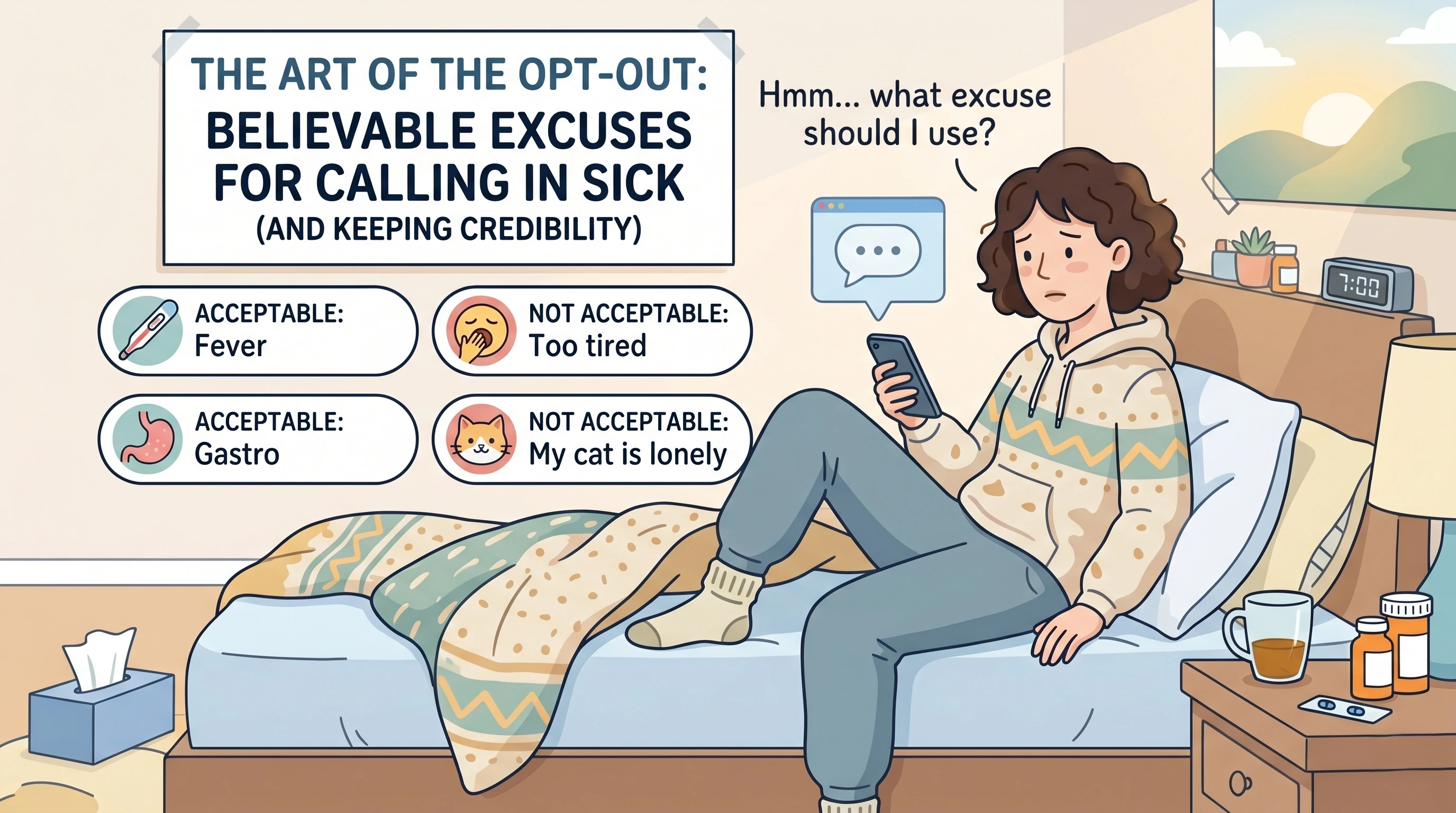
Need believable excuses for calling in sick? Use this quick list, copy-ready sick-day messages, what to avoid, and FAQs—grounded in honest, professional communication.
When you are genuinely unwell, handling a private matter, or need a supported mental health reset, the hard part is often the wording—not inventing a story. This guide focuses on brief, professional sick-day messages that match common real situations. Use only what is true for you, follow your employer’s attendance and leave policies, and treat “excuse” here as clear communication and boundaries, not encouragement to fabricate emergencies.
For a broader list of absence reasons (including transit and home emergencies), see our 50 professional reasons for missing work and good excuses to miss work guides.
Quick list: 12 believable excuses for calling in sick
If you need a send-and-forget option, these are common, low-friction reasons managers hear often—still keep yours aligned with what actually happened.
- Sudden migraine: hard to disprove and often debilitating.
- Food poisoning: a classic 24-hour issue that explains a sudden absence.
- Family emergency: broad enough to stay private, serious enough to be respected.
- Burst pipe / home maintenance: a physical emergency that requires you at home.
- Pet emergency: vet visits and urgent pet care are widely understood.
- Childcare issues: school closure or a sitter no-show can block work entirely.
- Severe toothache: dental pain is distracting and may need a same-day appointment.
- Mental health day: increasingly accepted in supportive workplaces when framed simply.
- Car trouble: if you cannot get there safely, on-site work is not possible.
- Allergic reaction: uncomfortable and visually obvious in many cases.
- Scheduled medical test: suggests a private, ongoing health matter.
- Stomach flu: the ultimate “please do not ask for details” category.
Deep dive: six professional call-out frameworks
Each scenario below includes a sample message. Replace placeholders and adjust tone to your workplace norms (Slack, text, email, or phone).
1. The 24-hour stomach bug
Best for: last-minute call-outs when you have not been acting sick beforehand.
Why it works: common, usually short-lived, and colleagues rarely want details.
Risk level: low (when accurate).
Example: “Hi [Manager Name], I have come down with a sudden stomach bug and will not be able to work today. I hope to be back tomorrow once it passes.”
2. The unforeseen family emergency
Best for: when you need time but do not want to share a physical illness detail.
Why it works: most managers avoid prying into family specifics.
Risk level: medium—use sparingly and only when real.
Example: “Hi [Manager Name], a family emergency came up this morning that needs my immediate attention. I will be offline today and will check in once things are settled.”
3. The home maintenance crisis
Best for: remote workers or anyone who must be present for repairs or safety.
Why it works: burst pipes, leaks, or utility issues are credible and time-bound.
Risk level: low (when accurate).
Example: “Morning [Manager Name], I woke up to a flooded kitchen from a burst pipe. I need to stay home for the plumber and cleanup. I will keep you posted on availability.”
4. Severe migraine
Best for: high-stress periods or heavy screen roles.
Why it works: migraines often include light sensitivity and nausea, which makes focused work difficult.
Risk level: low (when accurate).
Example: “I am dealing with a severe migraine this morning and need to stay in a low light environment. I will not be able to log on today but hope to return tomorrow.”
5. Childcare or dependent care snafu
Best for: parents and caregivers.
Why it works: third-party care is unreliable; closures and no-shows happen.
Risk level: low (when accurate).
Example: “My childcare fell through at the last minute today and I could not secure a backup. I need to take the day for dependent care.”
6. Under the weather (including mental health recovery)
Best for: burnout or wellness-forward workplaces.
Why it works: many teams treat “unwell” as including mental health; vague can be appropriate.
Risk level: medium depending on culture—check norms before oversharing.
Example: “I am not feeling well today and need a sick day to recover. I plan to be back tomorrow morning.”
Five funny excuses (friends and very casual contexts only)
These are not for your manager. Use only with close friends or playful group chats. For a much bigger collection, see our 100+ funny excuses.
- Mercury in retrograde: “The stars are misaligned; if I leave the house I might join a cult. Tomorrow!”
- Netflix betrayal: “I started a documentary and I am too emotionally invested in penguins to function.”
- Haunted house: “A ghost insists I stay for charades. It is a whole thing.”
- Wardrobe malfunction: “Skinny jeans happened. I need a seamstress and possibly a hydraulic rescue.”
- Pet intervention: “My cat is on the laptop and looks judgmental. I cannot disturb the peace.”
Excuses that usually backfire
- “I am hungover”: reads as unprofessional even if honest in some friendships.
- “My alarm did not go off”: sounds like disorganization, not illness.
- “I am at a concert or game”: easy to contradict with public posts or tags.
- Repeating major tragedies: recycling the same extreme story destroys trust fast.
- Vague “personal problems”: can sound evasive or alarming without a clear status line.
How to make your sick-day message more believable
- Be brief. One or two sentences beats a multi-paragraph saga.
- Do not over-explain. You rarely need a clinical play-by-play for a single day.
- Choose the right medium. Match your boss’s preference: Slack, text, email, or a quick call.
- Stay consistent with your story. If you are out sick, avoid broadcasting conflicting activity online.
Need personalized, professional wording?
Use the Excuse Generator to turn your real situation into a concise message with the tone you want. See how it works.
Frequently asked questions
What is the best excuse for calling in sick?
The most effective approach is usually a simple "I am unwell" or a short physical symptom you actually have (for example, stomach flu or migraine). It is relatable and needs little follow-up.
Are sick-day excuses safe to use?
Honest, proportional communication is safest. Repeated or exaggerated claims erode trust quickly. Follow your employer's policies on sick leave versus PTO and any documentation requirements.
What excuses work every time?
Nothing works every time for every manager. Medical appointments and genuine safety issues at home are often accepted because they are specific and externally verifiable when needed.
Should I call or text my boss?
Check your handbook or team norms. Text or email is common in 2026, but some leaders still prefer a brief phone message for same-day absences.
How many sick days is too many?
It depends on your contract, role, and pattern of use. Frequent Monday/Friday absences or clusters without context tend to raise questions regardless of wording.
Is it okay to use an excuse for a mental health day?
Yes, when your situation is real. If you are not comfortable saying "mental health," saying you are "unwell" or "not able to work today" can still be honest and professional.
What is the most believable excuse for being late?
External transit or traffic disruptions you cannot control are commonly understood—still keep them truthful and proportionate.
Can I get fired for a fake excuse?
Lying—especially about emergencies—can lead to discipline or termination if discovered, and it damages relationships even when it is not escalated. Stick to accurate summaries and policy-compliant leave types.
Summary
Strong excuses for calling in sick are really clear, minimal updates that match the truth, respect privacy, and set a realistic return expectation. You protect credibility by staying brief, consistent, and aligned with workplace rules.
When you want help phrasing it, use the Excuse Generator for a polished version in seconds.